
Lauren: Reflections on the first year of my PhD

Hi blog readers! I'm Lauren Carl, one of the PhD students in the Hope Lab, writing to provide some updates on the first year of my PhD.
What is my project about?
My project studies how anthropogenic disturbances to soft sediments impacts microbial processing of the benthic environment. With the current increase in atmospheric CO2, understanding how to mitigate further increases has been a topic of great interest to scientists. “Blue Carbon,” (BC) is a term for all carbon found in marine environments and encapsulates an area of marine science seeking to understand the extent of carbon storage and release in marine environments. Well-studied BC habitats, such as mangroves, seagrasses, and salt marshes, have been shown to store vast amounts of carbon given their relative size. This is great news for understanding how the environment removes carbon from the environment, but it is a double-edged sword. In the event of disturbance, these environments have the potential to release the stored carbon, transitioning them from BC “sinks” to BC “sources.” Furthermore, these environments have been well-studied in the scope of BC, but many other types of marine environments remain comparatively less explored. What can we learn from them?
Me giving a talk on my project back in June
Soft sediments, such as those found in intertidal flats or the seafloor, are important for the functioning of the ecosystem by supporting microbial and faunal communities, maintaining marine chemistry, and cycling carbon. Much like the classic BC habitats mentioned above, they have the capacity to store carbon in their sediments. While their storage potential may be less potent when thinking of carbon per given area, the total surface area of soft sediments across the globe is far higher, and thus as a whole store much more carbon than the small-but-mighty BC habitats. Furthermore, soft sediments are subject to much more human disturbance given their vast range. Anthropogenic disturbances, such as bottom-trawling, dredging, storms and floods, land-use changes, and bait-digging, are common in soft-sediment. These impacts have the potential to alter the sediment community, changing the delicate cycling within and facilitating carbon release. Understanding how anthropogenic disturbances impact carbon cycling in soft sediments through the lens of microbial and faunal processing is where my project comes into the equation.
What have I been up to so far?
My journey as a PhD student began in September of 2025. I spent the first four months exploring the literature around my topic and designing my first experiment. This experiment was an incubation experiment, where I took sediment samples from the Tay Estuary and added them to Kilner Jars (creating “mesocosms”). I wanted to mimic anthropogenic disturbances in my mesocosms, choosing to investigate how the physical mixing of sediment (such as that of bottom-trawling) and the addition of organic matter (as typically happens during bottom-trawling) impact microbial activity. Each mesocosm was assigned a treatment; sediment was left intact or homogenized (as a physical disturbance) and a dried algae powder was either added or excluded (as an organic matter addition). The algae added contained Carbon 13, which is less abundant in nature than the native Carbon 12. This allows me to “track” how the carbon in the algae move through the mesocosms and gain even more information about my experiment.
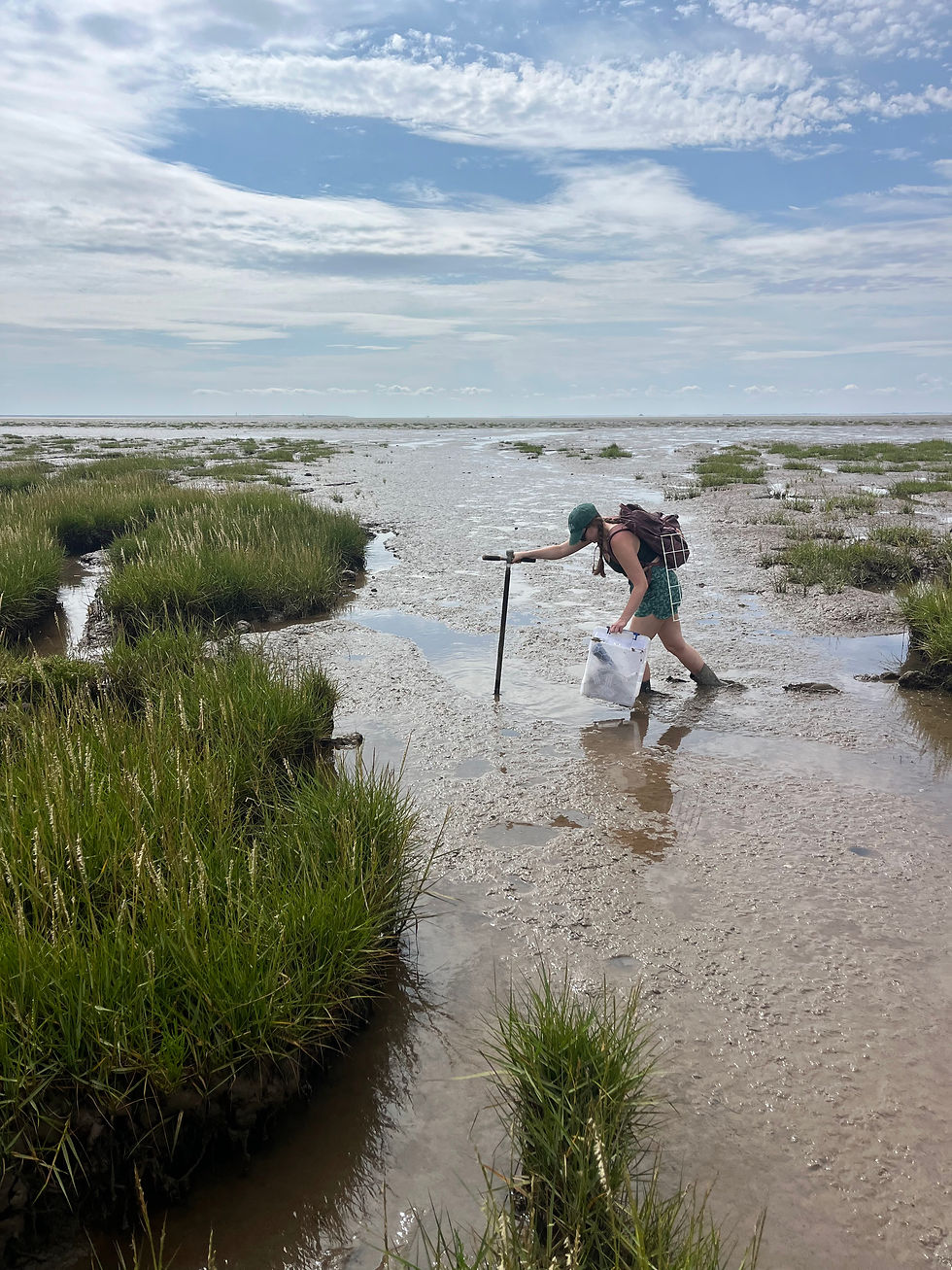
The experiment ran in June 2026, starting with securing the sediment from the Tay. It was a muddy endeavor, but all of my cores made it back to the Scottish Ocean Institute intact. The next few days consisted of preparing my algae, setting up my mesocosms, and slicing sediment. I was lucky to have some amazing helpers expedite the set-up, which took two days (instead of the likely week or more it would have taken alone). After a late night at the SOI getting the mesocosms sampled and sealed and wired up to the electrical system, the incubation experiment was underway. It ran for about five days, with three sampling timepoints spaced throughout as well as intermittent oxygen sampling. By the end of the experiment, I had water and sediment samples (to process for microbial and carbon content), raw oxygen data, and lots of dirty Kilner jars.
Me taking a core sample Me processing the sample A couple of my Kilner jars
After my experiment, I had to turn my attention to my 9-month review and am now preparing to head to Belfast to process my water samples using an IRMS (Isotope Ratio Mass Spectrometry) gas bench. Doing so will allow me to see how much carbon was released during the incubations and discern between the added Carbon 13 and the native Carbon 12. I hope to have all my samples processed, data analyzed, and chapter written up by the end of this year.
Looking forward...
It is hard to believe how fast the first year of my PhD has flown by. The beginning months of my PhD felt difficult as I battled a mountain of literature, the infamous imposter syndrome, and a brutal Scottish winter. As I made my way through my first experiment, however, I felt a growing confidence in my work and my abilities as a student. This year has been one of intense growth and adaptation, and I am lucky to have been well supported by Julie and the Hope Lab along the way. I look forward to what Year 2 of my PhD has in store and will be sure to keep the blog updated with what I get up to!
Getting some help with a core sample!


Comments